
OpenContract Engine: public procurement, published and steered on the OCDS standard.
OpenContract Engine is the EXOSDATA platform for publishing, checking and analysing public procurement data under the Open Contracting Data Standard (OCDS 1.1.5). It plugs into your existing procurement systems without replacing them, and runs in your own infrastructure.
- OCDS 1.1.5
- International open data standard
- 3 languages
- French, Arabic (right to left) and English
- 5 indicators
- Integrity signals computed every night
- 1 instance
- Per client, in its own infrastructure
- Procurement data is scattered across portals, business databases and files.
- Formats differ from one system to the next and cannot be compared.
- Donors and international partners expect open data in the OCDS standard.
- Decision-makers lack reliable indicators on lead times, competition and delivery.
The data exists, but nobody can use it or verify it.
A portal open to the public, a back office for your teams.
The public portal gives access to every procurement process, to statistics and to open data. The back office lets the authority configure sources, check quality and review indicators before publication.
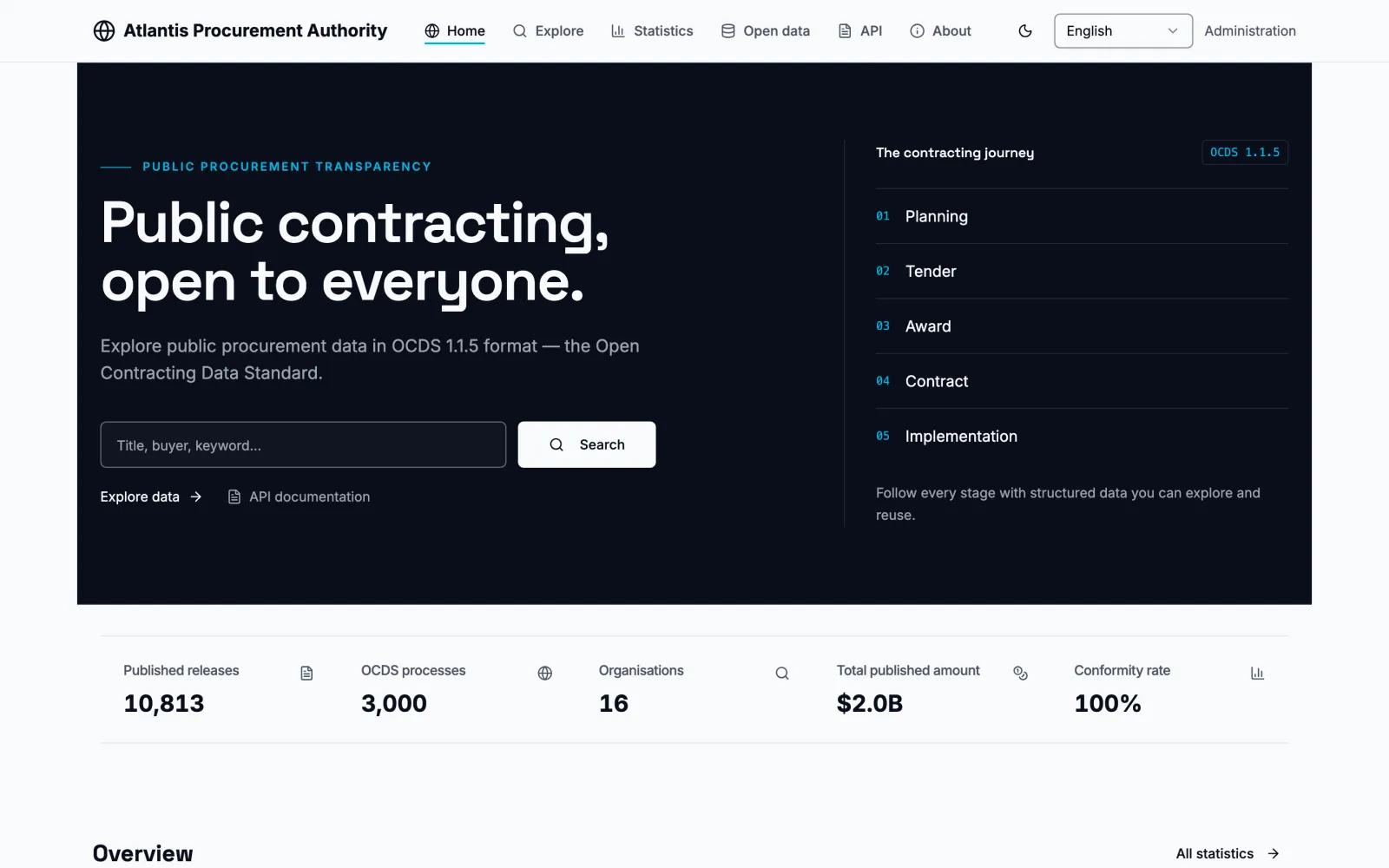
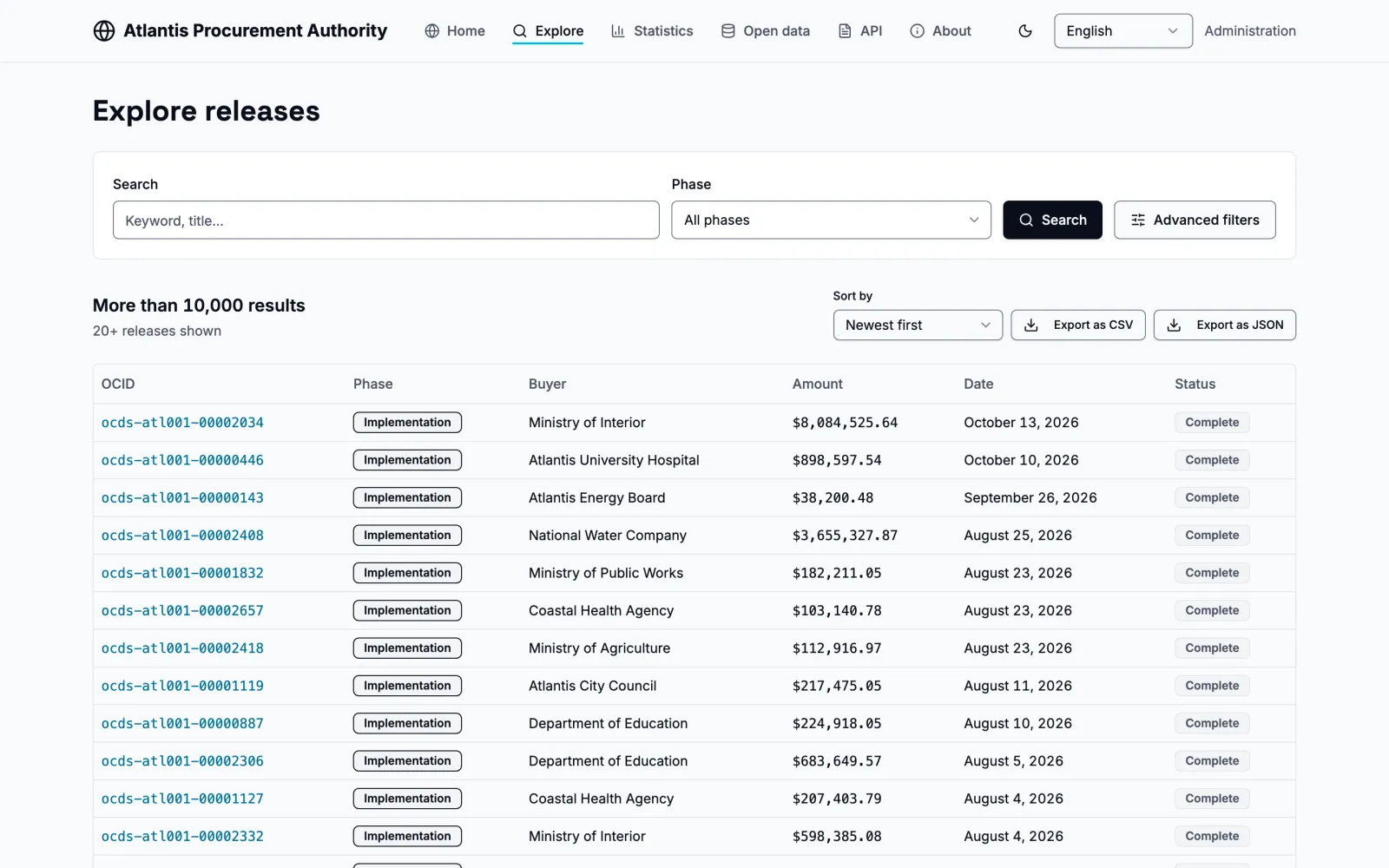
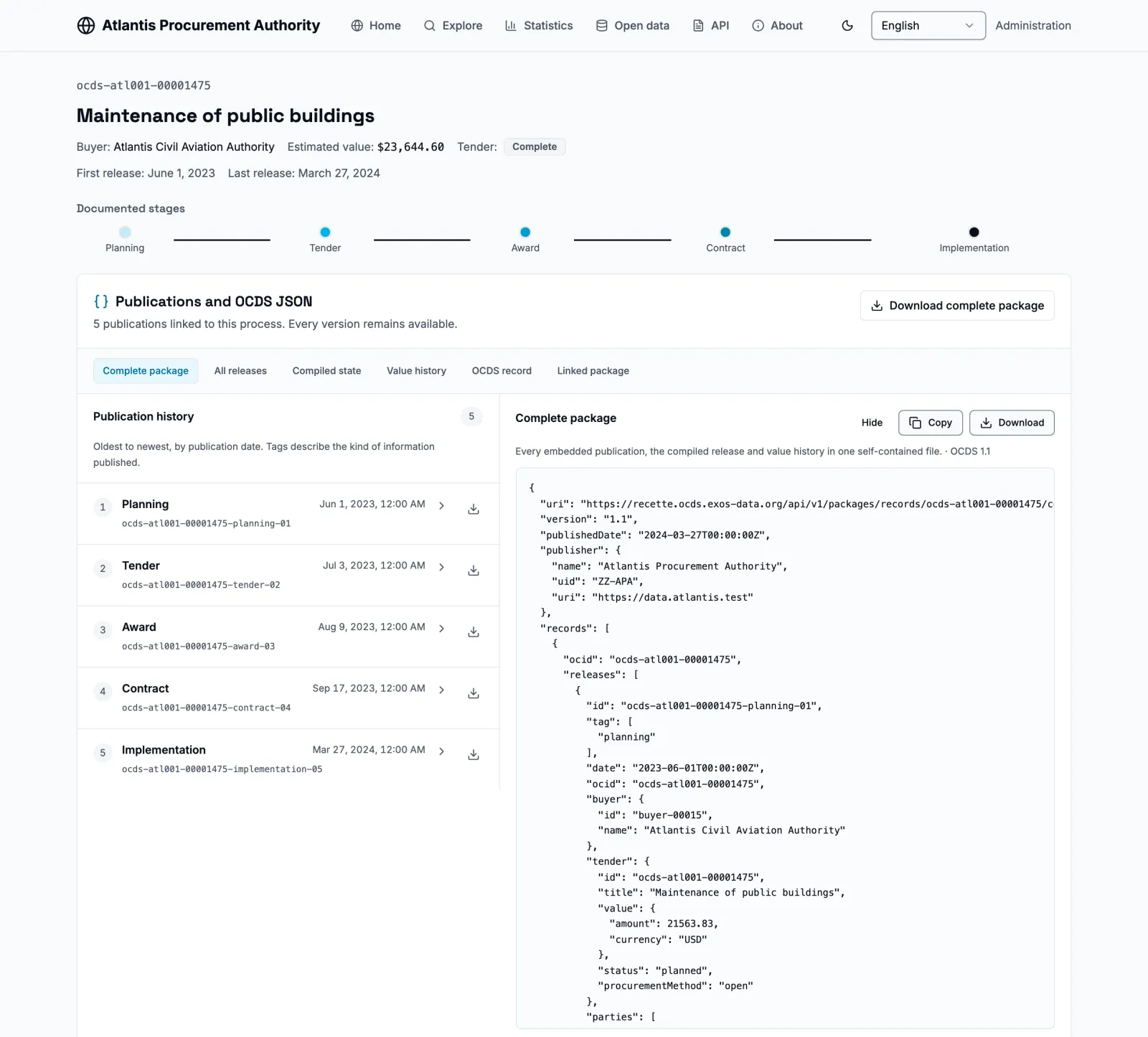
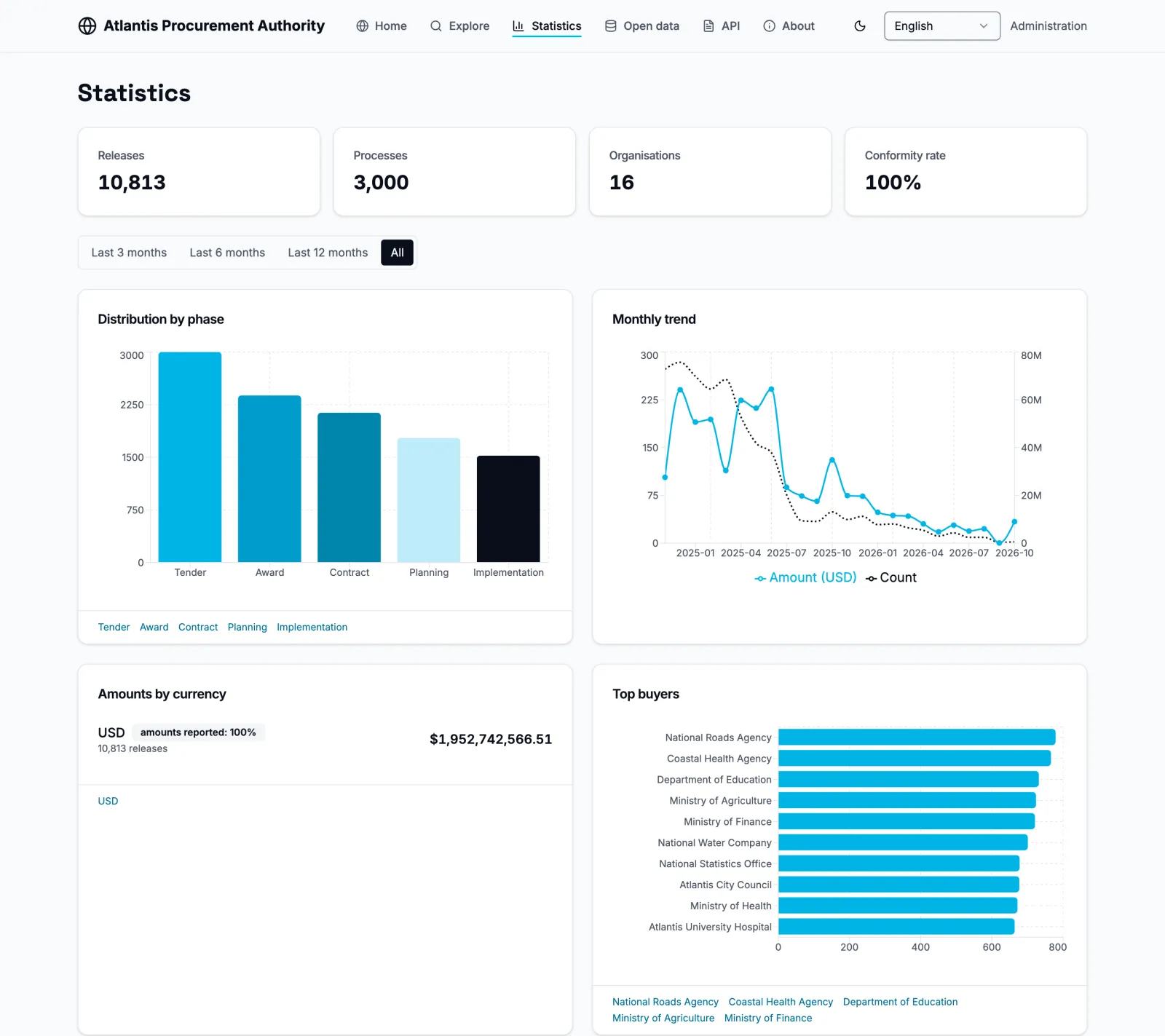
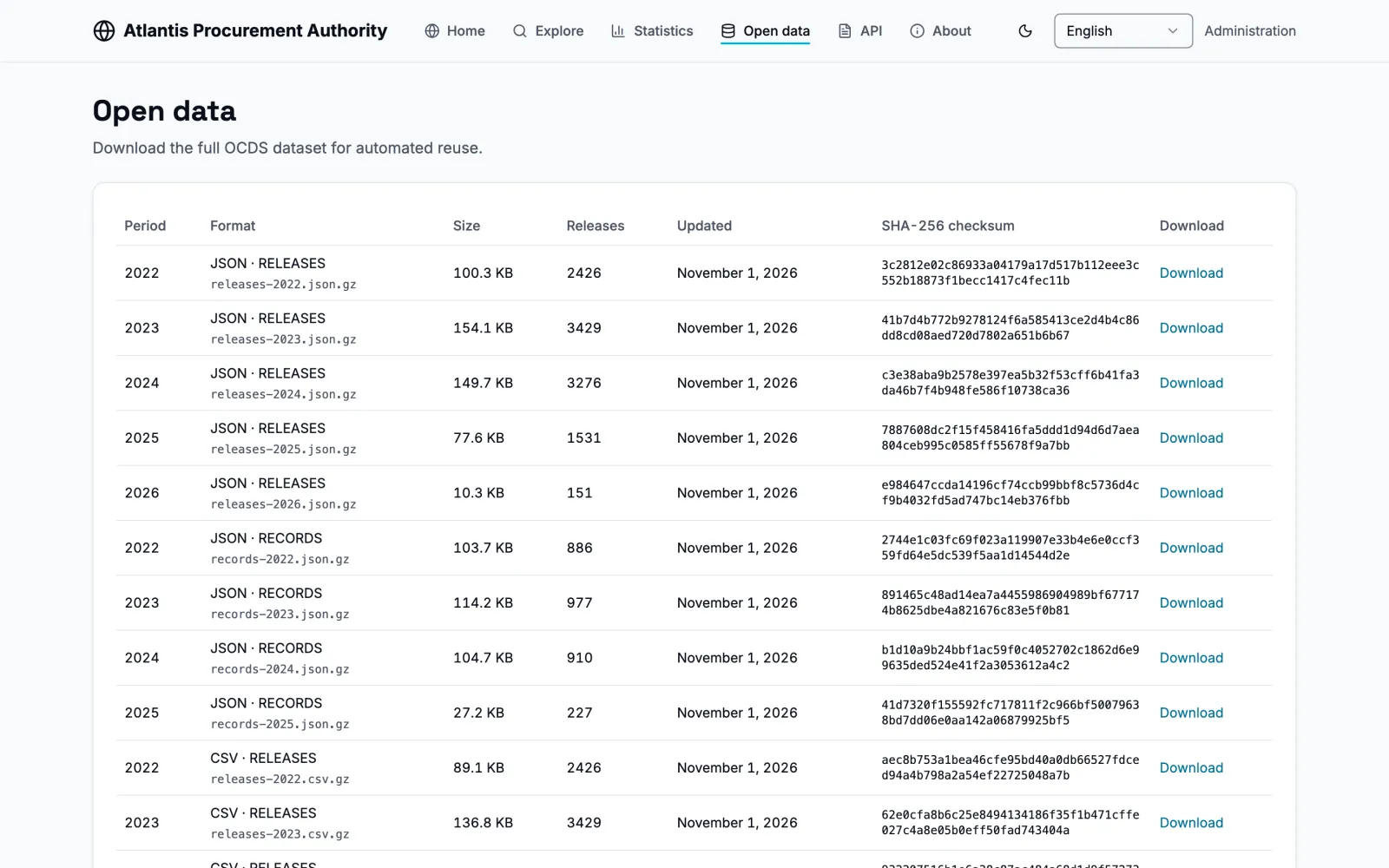
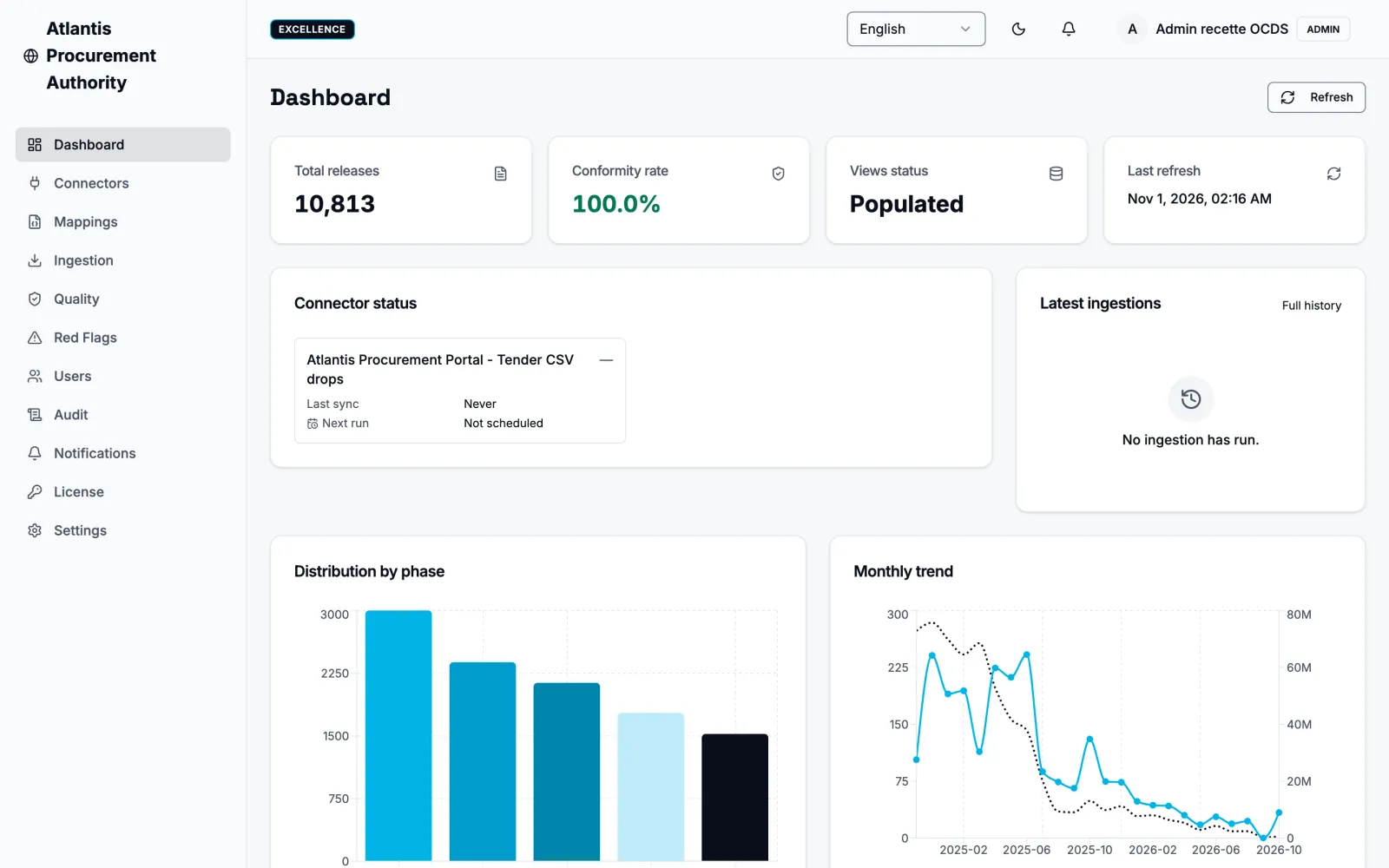
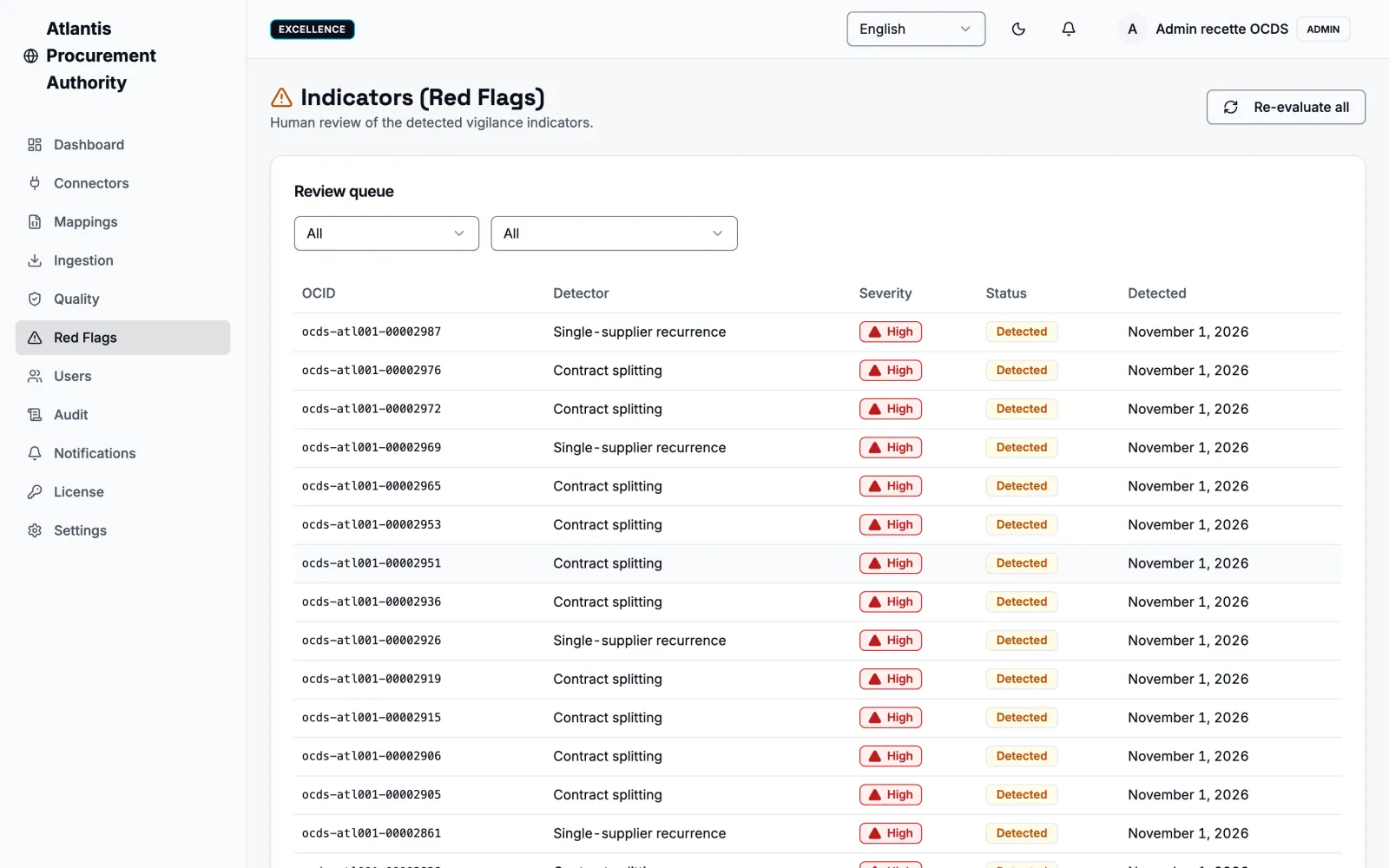
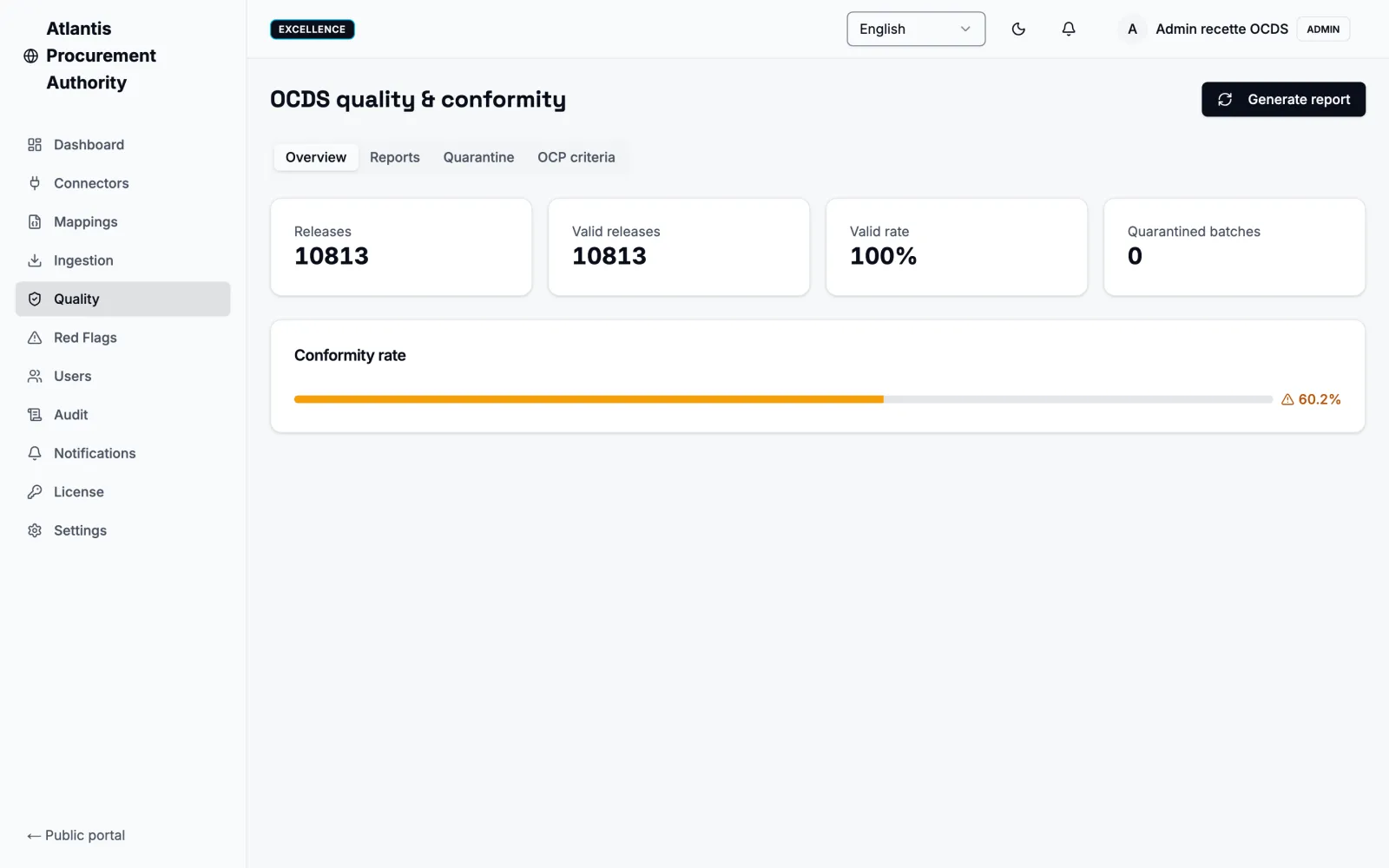
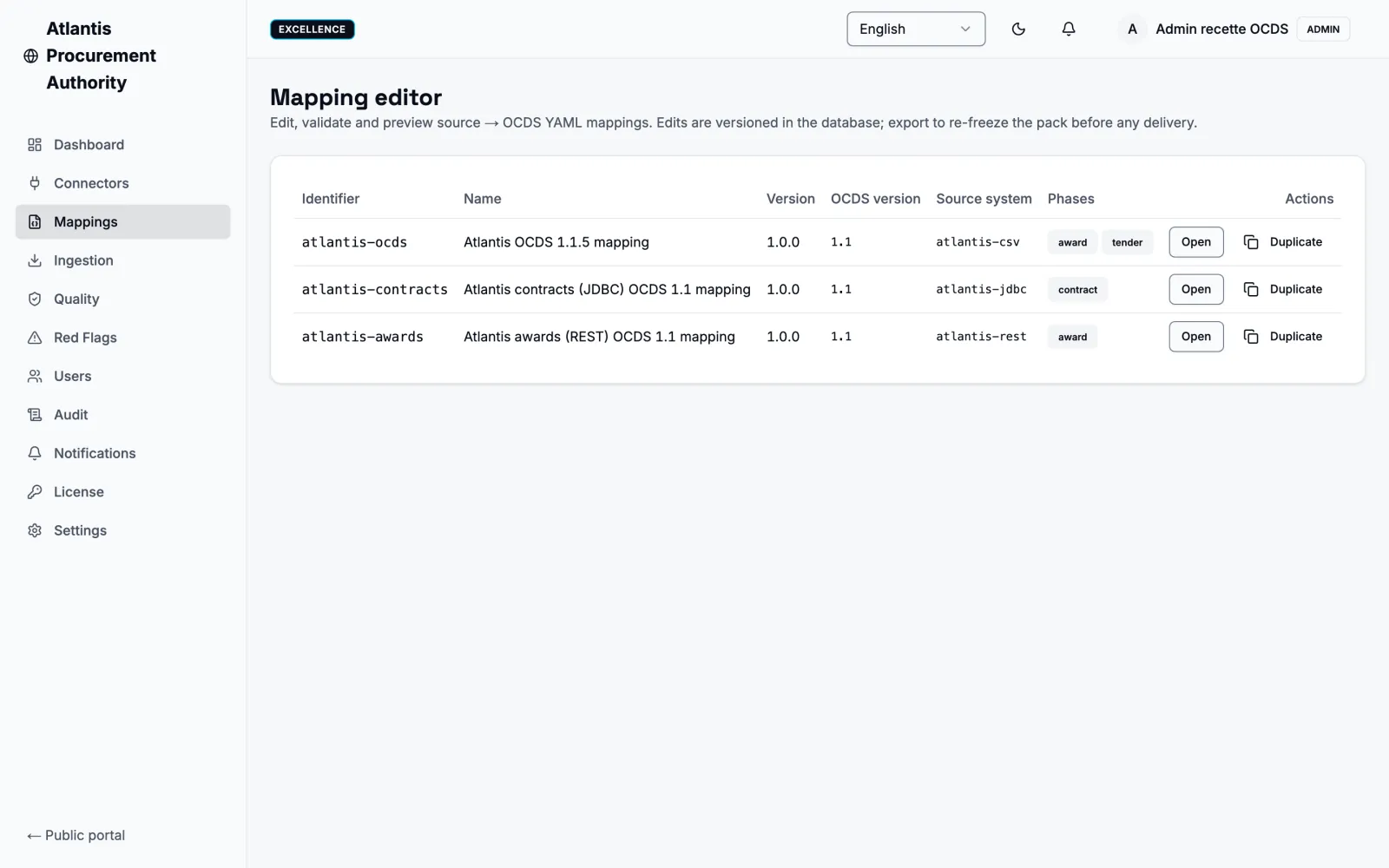
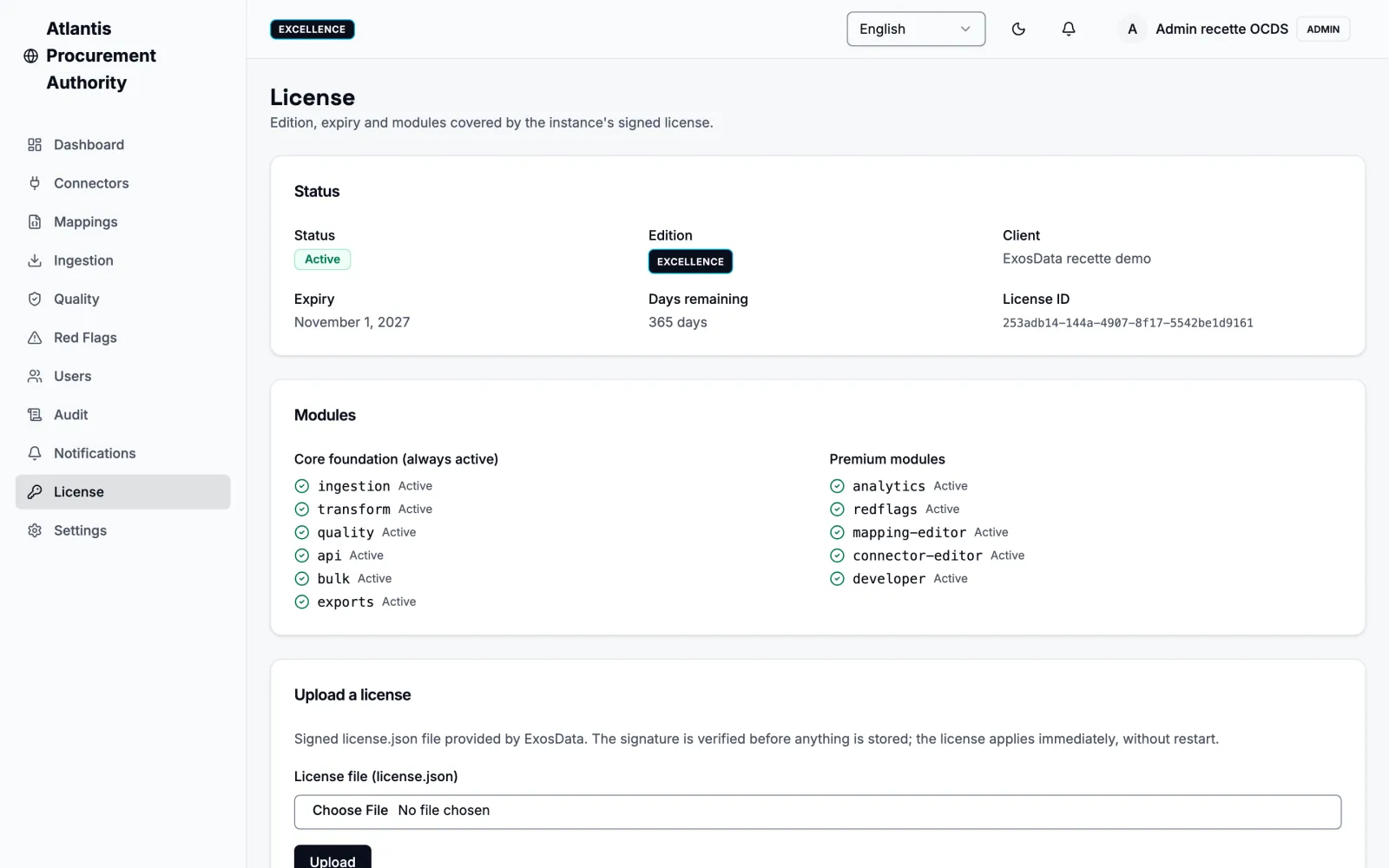
Screenshots taken on a demonstration instance loaded with fictitious data (the "Atlantis" country, 3,000 processes). The interface is available in French, Arabic and English.
From your source systems to an open portal, in four steps.
Collect
Connectors read your databases, files and APIs without changing the source systems.
Transform
Versioned mapping rules convert each procurement process to the OCDS format.
Validate
Every batch is checked before publication. Non-compliant batches are quarantined.
Publish
Data is opened through an API, bulk downloads and a public portal.
The whole procurement data lifecycle, in a single platform.
Configurable ingestion
- SFTP/CSV, database (JDBC) and REST API connectors.
- Set up through configuration, with no custom development.
- Dry-run mode before any publication, history of every run.
OCDS 1.1.5 compliance
- Process identifiers (OCID) that stay stable over time.
- A correction creates a new version and never overwrites the previous one.
- Publication policy open to everyone.
Connector and mapping editors
- Configuration changed from the back office, with no redeployment.
- Validated and tested on a sample before saving.
- Every version is kept and can be restored.
Public portal
- Search, filters and a detailed page for every process.
- Full release history for every process.
- Interface in French, Arabic and English.
Open data and API
- Documented REST API, with keys and quotas.
- Bulk downloads by year, with a SHA-256 fingerprint.
- JSON, CSV and Excel exports.
Developer portal
- Reusers create and manage their own API keys.
- Request examples and reference documentation.
- Usage tracking per key.
Statistics and dashboards
- Breakdown by phase, monthly trends, amounts by currency.
- Top buyers and suppliers, procurement methods.
- Public statistics and an internal dashboard.
Data quality
- Every release validated against the OCDS schema.
- Completeness score and quality criteria.
- Quarantine for non-compliant batches, periodic reports.
Administration and traceability
- Separate roles: administrator, operator, indicator reviewer, reader.
- Chained audit log whose integrity is checked in one click.
- Notifications on failures or anomalies.
Spot the processes that deserve a closer look, without ever accusing.
Every night, the platform computes five recognised public procurement risk indicators. Thresholds are set per country. Each signal goes through human review before it is published, and the calculation method is published on the portal.
- Contract splitting: purchases cut up to stay below procedure thresholds.
- Recurring single supplier: the same winner, process after process, at the same buyer.
- Buyer and supplier concentration: an unusual share of the amounts captured by one supplier.
- Gap between estimate and award: an awarded amount far from the estimate.
- Publication delay: a bidding period too short for real competition.
Three editions, one platform.
Every edition runs the same engine. The licence switches on additional modules without reinstalling, including on isolated networks.
Publish
- OCDS ingestion, transformation and validation.
- Public portal, API and open data.
- JSON, CSV and Excel exports, quality control.
Analyse
- Everything in Core.
- Statistics and dashboards.
- Integrity indicators and review queue.
- Connector editor.
Open up and control
- Everything in Advanced.
- OCDS mapping editor.
- Developer portal and API key management.
- Procurement regulators and observatories: measure and report.
- Ministries, treasuries and procurement agencies: publish without rebuilding existing systems.
- Local authorities and public bodies: open their procurement data.
- IT departments: a platform installed, operated and controlled in-house.
Designed for public sector infrastructure.
- Model
- One dedicated instance per client, installed in its own infrastructure
- Delivery
- Docker Compose or Helm chart (Kubernetes), including isolated networks with no internet access
- Integrity
- Signed delivery bundles and images, verified before installation
- Security
- Role management, chained audit log, quotas on the public API
- Operations
- Encrypted backups, documented restore and disaster recovery, diagnostic tool, monitoring
- Upgrades
- Tooled version upgrades, with a prior compatibility check
- Localisation
- A country pack carries the connectors, mappings and code lists specific to each jurisdiction
- Stack
- Java 21 · Spring Boot · PostgreSQL 17 · Next.js
- Licence
- Signed annual licence, with maintenance and support
It complements your procurement systems, it does not replace them.
OpenContract Engine does not handle bid submission, evaluation or contract signature. It sits on top of existing systems to publish and analyse their data. How complete the published data is depends on what the source systems hold.